
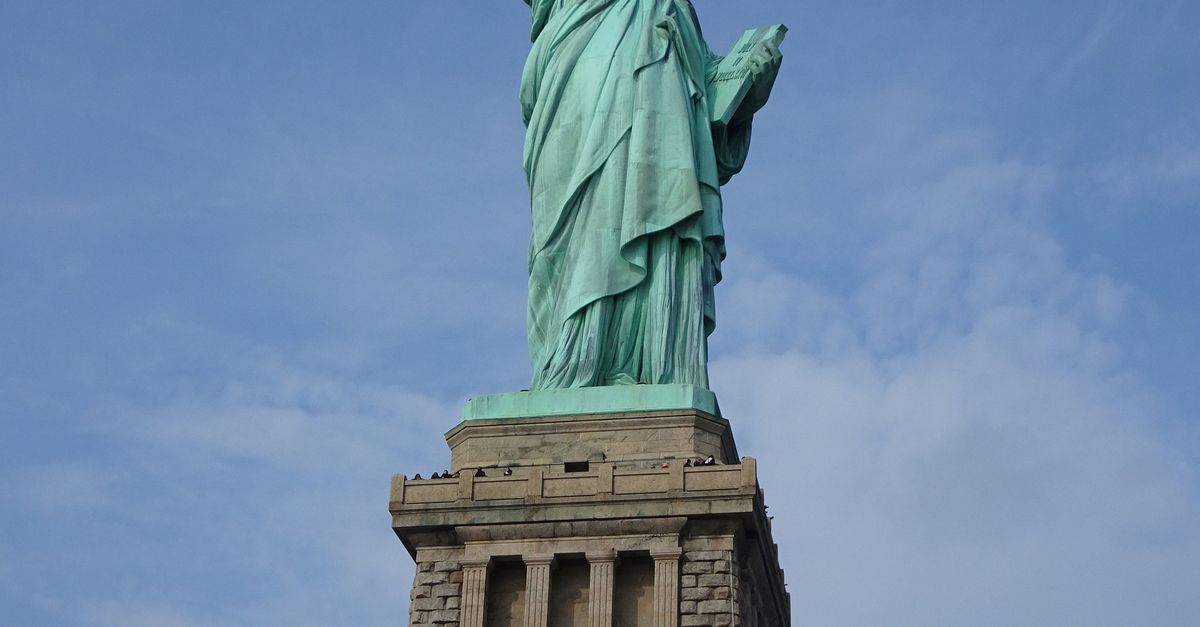
1. Statue of Liberty, New York
The Statue of Liberty stands on Liberty Island in New York Harbor and remains the most globally recognized symbol of the United States. Dedicated in 1886 as a gift from France, the copper statue rises 305 feet from base to torch. Designed by Frédéric Auguste Bartholdi, it represents freedom and democracy. More than 4 million visitors explore Liberty Island annually, and the monument continues to symbolize immigration, as over 12 million immigrants passed through nearby Ellis Island between 1892 and 1954.
2. White House, Washington, D.C.
The White House has functioned as the official home and office for every American president starting with John Adams in 1800. Created by James Hoban, the neoclassical estate features 132 rooms alongside 35 bathrooms. Serving simultaneously as an active administrative center and a worldwide symbol of U.S. presidential authority, broadcasts of state visits, televised speeches, and historic pacts originating from the White House continuously influence how the global community views the country.
3. Mount Rushmore, South Dakota
Carved into the Black Hills between 1927 and 1941, Mount Rushmore features the 60-foot faces of Presidents George Washington, Thomas Jefferson, Theodore Roosevelt, and Abraham Lincoln. Sculpted by Gutzon Borglum, the monument represents foundational moments in U.S. history: independence, expansion, development, and preservation. Nearly 2 million visitors view the granite sculpture each year.
4. Golden Gate Bridge, California
Spanning 1.7 miles across the Golden Gate Strait, the Golden Gate Bridge connects San Francisco to Marin County. Completed in 1937, the suspension bridge was once the longest and tallest in the world. Its International Orange color and Art Deco styling make it instantly recognizable. The bridge carries over 100,000 vehicles daily and remains a triumph of twentieth-century engineering.
5. Grand Canyon, Arizona
The Grand Canyon stretches 277 miles long, up to 18 miles wide, and over a mile deep. Carved by the Colorado River over millions of years, it attracts nearly 5 million visitors annually. Designated a national park in 1919 and a UNESCO World Heritage Site in 1979, the canyon represents America’s vast natural beauty and geological history.
6. Empire State Building, New York
Completed in 1931 during the Great Depression, the Empire State Building rises 1,454 feet including its antenna. For nearly 40 years, it was the tallest building in the world. Its Art Deco design and illuminated crown define the Manhattan skyline. The observatories on the 86th and 102nd floors attract millions of visitors each year.
7. Hollywood Sign, California
Overlooking Los Angeles, the Hollywood Sign was erected in 1923 as a real estate advertisement reading “Hollywoodland.” Today, the nine-letter sign represents the global film and entertainment industry. Situated on Mount Lee in the Hollywood Hills, it is one of the most photographed landmarks in the world.
8. Lincoln Memorial, Washington, D.C.
The Lincoln Memorial, inaugurated in 1922, pays tribute to President Abraham Lincoln. Crafted by Daniel Chester French, the 19-foot marble sculpture rests inside a temple-like edifice inspired by ancient Greek design. This historic landmark has provided the setting for momentous occasions, such as the 1963 “I Have a Dream” address delivered by Martin Luther King Jr.
9. Washington Monument, Washington, D.C.
Standing 555 feet tall, the Washington Monument is the world’s tallest stone obelisk. Completed in 1884, it commemorates the nation’s first president. Its simple yet imposing design dominates the National Mall skyline and symbolizes the country’s founding ideals.
10. Times Square, New York
Known as “The Crossroads of the World,” Times Square is renowned for its dazzling billboards, Broadway playhouses, and the New Year’s Eve ball drop tradition, drawing over 1 million participants each year alongside countless global spectators. Situated in Midtown Manhattan, this vibrant hub epitomizes American business, media, and entertainment culture.
11. The Alamo, Texas
The Alamo in San Antonio is a former Spanish mission and the site of the 1836 Battle of the Alamo during the Texas Revolution. Although modest in size, it represents resilience and sacrifice. Over 2.5 million people visit each year to learn about its historical significance.
12. Niagara Falls, New York
Straddling the border between the United States and Canada, Niagara Falls is one of the most powerful waterfalls in North America, with more than 3,100 tons of water flowing per second at peak times. The American Falls and Bridal Veil Falls lie within U.S. territory. The site draws approximately 8 to 9 million visitors annually.
13. Walt Disney World Resort, Florida
Established in 1971 close to Orlando, Walt Disney World Resort stands as the globe’s most frequented holiday destination, drawing approximately 58 million visitors yearly across its amusement parks. The iconic Cinderella Castle situated within Magic Kingdom has evolved into an immediately identifiable landmark linked to American family amusement and creativity.
14. Las Vegas Strip, Nevada
The Las Vegas Strip is a 4.2-mile stretch known for its luxury resorts, casinos, and replica landmarks. With over 40 million visitors per year, it symbolizes American leisure, nightlife, and large-scale entertainment. Iconic hotels such as the Bellagio and Caesars Palace contribute to its global recognition.
15. Space Needle, Washington
Built for the 1962 World’s Fair in Seattle, the Space Needle rises 605 feet into the air. Its futuristic aesthetic embodies the optimism characteristic of the Space Age. Updates have since refreshed its viewing platform, incorporating glass floors and transparent walls to cement its status as an emblem of ingenuity and visionary architecture.
The Enduring Power of American Landmarks
From natural wonders carved over millions of years to architectural achievements built within a single generation, America’s most recognizable landmarks reflect ambition, diversity, and evolving identity. Some embody political ideals and democratic governance; others celebrate entertainment, engineering, or the sheer scale of the landscape. Together, they form a visual narrative of a nation shaped by history, creativity, conflict, and aspiration—places where collective memory and modern life continue to intersect.